Appearance
Advanced Example
Elementor Pro AdvancedFor a more advanced use-case, we're going to create an addon that registers conditions based on the role of a logged-in visitor. The addon will help Elementor users to display some templates only to visitors with specific roles.
Folder Structure
The addon will have three files. Two files for the conditions and the main file to register the condition and handle all the other stuff.
elementor-user-role-conditions/
|
├─ theme-conditions/
|  ├─ logged-in-user-condition.php
|  └─ user-role-condition.php
|
└─ elementor-user-role-conditions.phpPlugin Files
elementor-user-role-conditions.php
php
<?php
/**
 * Plugin Name: Elementor User Role Conditions
 * Description: Custom addon that adds user role conditions to Elementor.
 * Plugin URI:  https://elementor.com/
 * Version:     1.0.0
 * Author:      Elementor Developer
 * Author URI:  https://developers.elementor.com/
 * Text Domain: elementor-user-role-conditions
 *
 * Requires Plugins: elementor
 * Elementor tested up to: 3.25.0
 * Elementor Pro tested up to: 3.25.0
 */

if ( ! defined( 'ABSPATH' ) ) {
	exit; // Exit if accessed directly.
}

/**
 * Add user role conditions to Elementor.
 *
 * @since 1.0.0
 * @param \ElementorPro\Modules\ThemeBuilder\Classes\Conditions_Manager $conditions_manager An instance of conditions manager.
 * @return void
 */
function add_new_user_role_conditions( $conditions_manager ) {

	require_once( __DIR__ . '/theme-conditions/logged-in-user-condition.php' );
	require_once( __DIR__ . '/theme-conditions/user-role-condition.php' );

	$conditions_manager->get_condition( 'general' )->register_sub_condition( new \Logged_In_User_Condition() );
}
add_action( 'elementor/theme/register_conditions', 'add_new_user_role_conditions' );theme-conditions/logged-in-user-condition.php
php
<?php
if ( ! defined( 'ABSPATH' ) ) {
	exit; // Exit if accessed directly.
}

/**
 * Elementor Logged-In User Condition.
 *
 * Add a logged-in user condition to Elementor.
 *
 * @since 1.0.0
 */
class Logged_In_User_Condition extends \ElementorPro\Modules\ThemeBuilder\Conditions\Condition_Base {

	/**
	 * Get condition group type.
	 *
	 * Retrieve logged-in user condition group type.
	 *
	 * @since 1.0.0
	 * @access public
	 * @return string
	 */
	public static function get_type(): string {
		return 'general';
	}

	/**
	 * Get condition name.
	 *
	 * Retrieve logged-in user condition unique ID.
	 *
	 * @since 1.0.0
	 * @access public
	 * @return string
	 */
	public function get_name(): string {
		return 'logged_in_user';
	}

	/**
	 * Get condition label.
	 *
	 * Retrieve logged-in user condition label.
	 *
	 * @since 1.0.0
	 * @access public
	 * @return string
	 */
	public function get_label(): string {
		return esc_html__( 'Logged-in User', 'elementor-user-role-conditions' );
	}

	/**
	 * Get condition all label.
	 *
	 * Retrieve logged-in user condition 'All' label.
	 *
	 * @since 1.0.0
	 * @access public
	 * @return string
	 */
	public function get_all_label(): string {
		return esc_html__( 'Any user role', 'elementor-user-role-conditions' );
	}

	/**
	 * Register sub-conditions.
	 *
	 * Add sub-conditions based on user role.
	 *
	 * @since 1.0.0
	 * @access public
	 * @return void
	 */
	public function register_sub_conditions(): void {
		global $wp_roles;

		if ( ! isset( $wp_roles ) ) {
			$wp_roles = new \WP_Roles();
		}

		$user_roles_list = $wp_roles->get_names();

		foreach ( $user_roles_list as $role ) {
			$this->register_sub_condition( new \User_Role_Condition( $role ) );
		}
	}

	/**
	 * Check condition.
	 *
	 * Validate logged-in user condition to ensure it complies to certain rules.
	 *
	 * @since 1.0.0
	 * @access public
	 * @return bool
	 */
	public function check( $args ): bool {
		return is_user_logged_in();
	}

}theme-conditions/user-role-condition.php
php
<?php
if ( ! defined( 'ABSPATH' ) ) {
	exit; // Exit if accessed directly.
}

/**
 * Elementor User Role Conditions.
 *
 * Add a user role conditions to Elementor.
 *
 * @since 1.0.0
 */
class User_Role_Condition extends \ElementorPro\Modules\ThemeBuilder\Conditions\Condition_Base {

	/**
	 * Condition constructor.
	 *
	 * Initialize user role condition.
	 *
	 * @since 1.0.0
	 * @access public
	 * @return string
	 */
	public function __construct( $user_role ) {
		parent::__construct();

		$this->user_role = $user_role;
	}

	/**
	 * Get condition group type.
	 *
	 * Retrieve user role condition group type.
	 *
	 * @since 1.0.0
	 * @access public
	 * @return string
	 */
	public static function get_type(): string {
		return 'logged_in_user';
	}

	/**
	 * Get condition name.
	 *
	 * Retrieve user role condition unique ID.
	 *
	 * @since 1.0.0
	 * @access public
	 * @return string
	 */
	public function get_name(): string {
		return strtolower( $this->user_role . '_role' );
	}

	/**
	 * Get condition label.
	 *
	 * Retrieve user role condition label.
	 *
	 * @since 1.0.0
	 * @access public
	 * @return string
	 */
	public function get_label(): string {
		/* translators: %s: User role label. */
		return sprintf( esc_html__( '%s role', 'elementor-user-role-conditions' ), $this->user_role );
	}

	/**
	 * Check condition.
	 *
	 * Validate user role condition to ensure it complies to certain rules.
	 *
	 * @since 1.0.0
	 * @access public
	 * @return bool
	 */
	public function check( $args ): bool {
		$current_user = wp_get_current_user();
		$site_roles = (array) $current_user->roles;
		return in_array( $this->user_role, $site_roles );
	}

}The Result
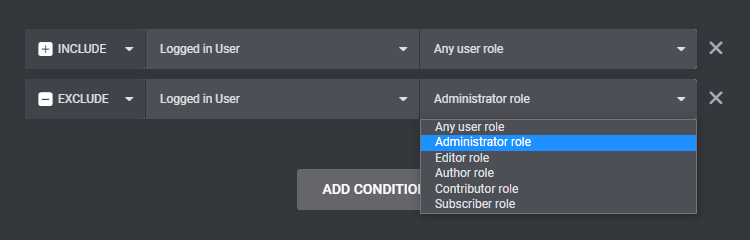
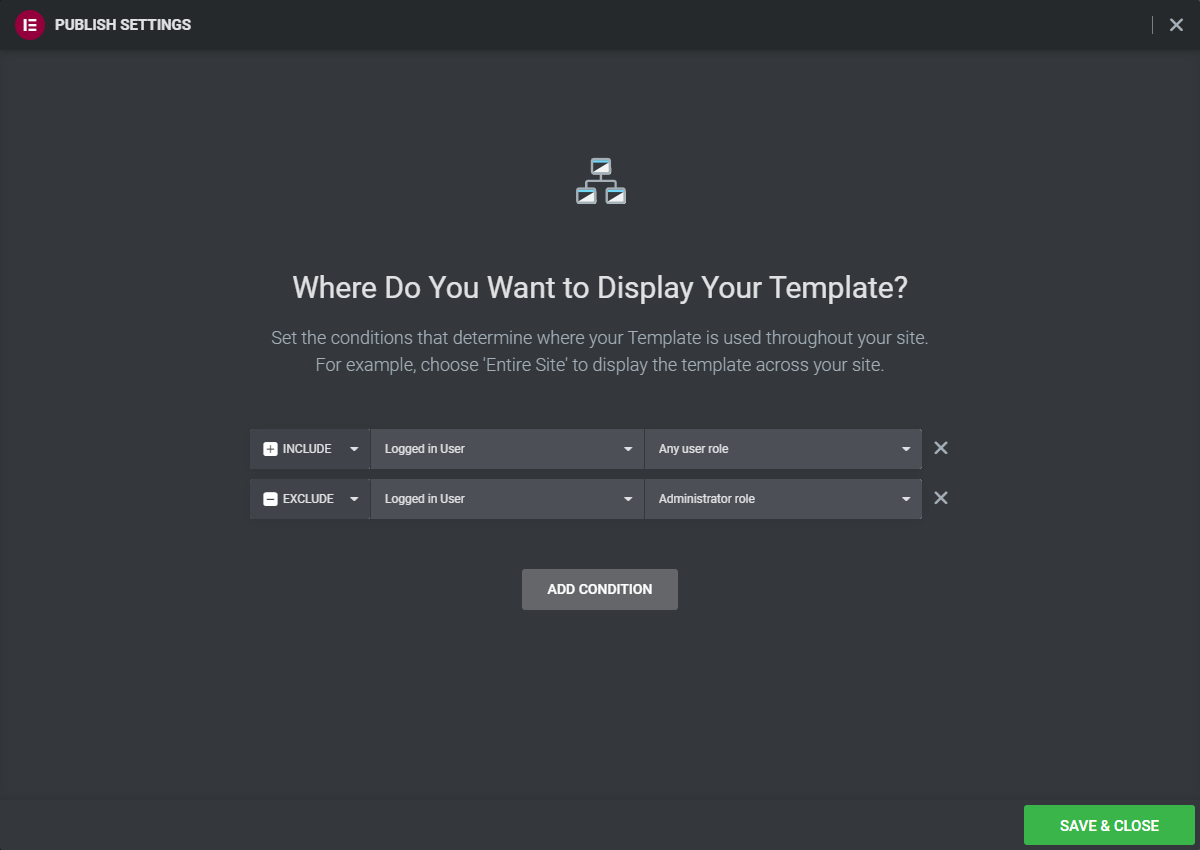
The "Logged-In User" > "User Roles" conditions:
The "User Roles" list: